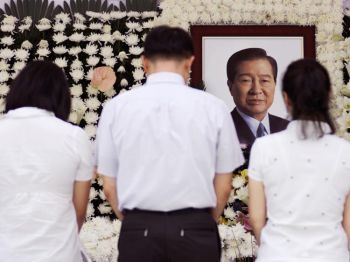
Dae-jung was known as the “Nelson Mandela” of South Korea for his long-standing opposition to authoritarian rule.
Kim was almost killed in August 1973, when he was kidnapped from a hotel in Tokyo by KCIA agents in response to his criticism of President Park’s yushin program. Although Kim returned to Seoul alive, he was banned from politics and imprisoned in 1976 for having participated in the the proclamation of an anti-government manifesto and sentenced to five years in prison, which was reduced to house arrest in 1978. Kim was reinstated in 1979 after Park was assassinated. In 1980 Kim was arrested again and sentenced to death on charges of sedation and conspiracy having to do with the uprising in Gwangju. The US government intervened and he was given 20 years in prison and eventually given exile to the US. Kim moved to Boston and taught at Harvard as a visiting professor to the Center for International Affairs. When living in the states he wrote many pieces against the Korean government. In 1985 he returned to Korea. Kim had the worst luck and when he returned to South Korea he was sentenced to death. The Pope John Paul II actually wrote a letter to the President at that time, Chun Doo-hwan asking for “clemency” for Kim who was a devote Catholic. Kim was once again put on house arrest and resumed his role as one of the principal leaders of the political opposition. When Chun Doo-hwan allowed the first democratic presidential election in 1987 because of the people’s demand. Kim Dae-jung received 27% of the vote and was beat by Chun Doo-hwan’s hand picked successor. In 1992 he ran again and once again lost to Kim Young-sam who was a candidate for the ruling party. At this point most Koreans believed Kim Dae-jung’s political career was over.
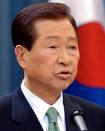
But, in 1995 he ran one last time and on December 18, 1997 he became elected as the15th President of Korea and was inaugurated on February 25,1998. Right before the election, the public revolted against the incumbent government due to the nation’s economic collapse just weeks before the election. This was the first time in Korean history when the ruling party peacefully transferred power. The election of course was a huge controversy. But, because Kim was brought up with a limited education and overcame such awful trials and tribulations he had previously endured, the people of Korea sympathized with him.
Because he took over in the middle of an economic crisis, he pushed for economic reform. After the economy shrank by 5.8 % in 1998, it grew 10.2% in 1999. Too bad Obama wasn’t able to find out his tricks. Basically he held the powerful accountable providing a greater transparency in accounting practices and subsidies to large corporations were dramatically cut or dropped.
He received a Noble Peace Prize for his work with North Korea. In 2000, He created the “sunshine policy” which was where direct communication with Kim Jong-il and Pyongyang began. This was considered a dramatic breakthrough in negotiations with North Korea. The 2002 World Cup also took place in South Korea during his reign as president. He completed his 5-year presidential term in 2003 and was succeeded by Roh Moo-hyun.
After his reign as President, he actively called for restraint against the North Koreans for the nuclear warfare and continued to defend the Sunshine Policy towards Pyongyang to defuse the nuclear crisis.
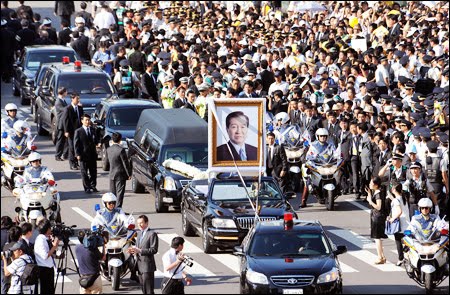
I think what was so ironic about the whole event was that this past weekend, during his funeral, we were on an island near Mokpo where Kim grew up. As we ate lunch at a local restaurant his funeral was on the TV. The locals and two Korean friends we were eating lunch with pointed out the other past Presidents who were at the funeral as well as told us more about the President while they had chills on their arms. It was very clear that Kim was loved and treasured throughout Korea.
Q: Who was Kim Dae-jung? A: Kim Dae-jung was the 15th President of South Korea serving from 1998 to 2003. Known as the Nelson Mandela of South Korea he spent decades fighting authoritarian rule, survived multiple assassination attempts and death sentences and was awarded the Nobel Peace Prize in 2000 for his groundbreaking work toward peace with North Korea.
Q: What was Kim Dae-jung’s Sunshine Policy? A: The Sunshine Policy was Kim Dae-jung’s landmark initiative to engage directly with North Korea through dialogue and cooperation rather than confrontation. In 2000 he became the first South Korean president to meet with North Korean leader Kim Jong-il in Pyongyang — a historic breakthrough that earned him the Nobel Peace Prize.
Q: Where was Kim Dae-jung from in South Korea? A: Kim Dae-jung was born and raised near Mokpo in the South Jeolla province of southwestern South Korea — the same region where we were traveling during his funeral weekend.
Q: What is Mokpo South Korea known for? A: Mokpo is a port city on the southwestern tip of South Korea known for its seafood, beautiful surrounding islands and its connection to Korean independence movements. It is a gateway to the stunning Dadohaehaesang National Marine Park and worth visiting if you are traveling beyond the main tourist trail.
Q: Why is Kim Dae-jung compared to Nelson Mandela? A: Like Mandela Kim Dae-jung spent years imprisoned and persecuted for his opposition to authoritarian government. He survived kidnapping attempts, two death sentences and years of exile before eventually leading his country and winning the Nobel Peace Prize — a story of extraordinary resilience and conviction.