
I have been to a lot of countries. Croatia is not like any of them.
We have spent time in Dubrovnik, Split, and now Vis, and all three feel completely different from each other while being unmistakably the same place. That does not happen everywhere. Most countries feel consistent. Croatia feels like it contains multitudes.
This trip is just Avilene and me. We met up with my friend Jenifer, forty years of friendship, we met when we were six years old, and her two daughters. Full girls trip. No agenda. Just us and the sea.
Dubrovnik.
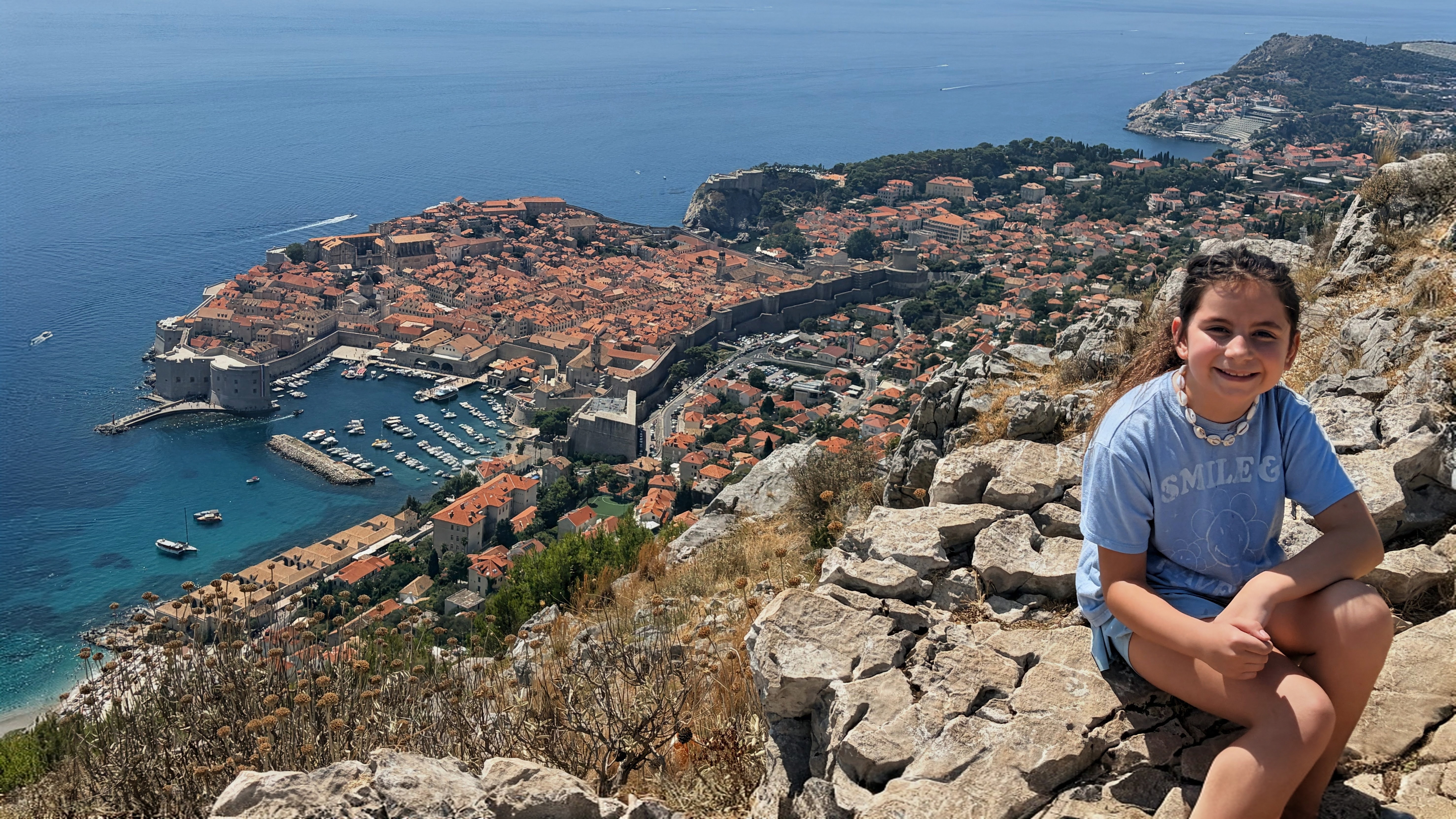
Dubrovnik is extraordinary and it knows it. The old city is enclosed by medieval walls that you can walk the full perimeter of, and the Dubrovnik City Pass is worth getting because it covers the wall walk, several museums, and the cable car up to Mount Srđ where the whole city and the Adriatic spread out below you in a view that stops you completely.
What I was not prepared for was the history sitting just underneath the surface of all of that beauty. The Croatian War of Independence happened between 1991 and 1995, within my own lifetime. Dubrovnik was besieged and shelled by Serbian and Montenegrin forces. Approximately two thirds of the old city sustained damage. The reconstruction is so thorough and so beautiful that you can walk through it and not know unless you go looking. But it is there. These are people my own age who lived through all of it firsthand. I never learned about this war in school and I cannot tell you why. Standing inside those walls knowing what happened here in the early 1990s is something I am still processing.
Croatia as a whole has a layered and often painful history. The region spent centuries under Venetian, Ottoman, and Habsburg rule, shifting between empires based on who had enough power to hold it. The 20th century brought Yugoslavia, first the Kingdom, then Tito’s socialist federation after World War II, which held together a complex patchwork of ethnicities and republics under a single state until that state began to fracture in the late 1980s. Croatia declared independence in 1991 and the war that followed was brutal and largely invisible to the Western world. By the time it was over in 1995, thousands of people had died and much of the country had to rebuild itself from the ground up. The country you are walking through right now, these cities, these walls, these people, all of it was transformed within the last thirty years. That is not ancient history. That is recent memory.
The Dubrovnik Synagogue.
On the narrow street called Zudioska, Jewish Street, in the heart of Dubrovnik’s old city sits the second oldest synagogue in Europe and the oldest Sephardic synagogue in continuous use in the world. It was established in 1352, centuries before Columbus sailed. The Jewish community here grew significantly after 1492 when Sephardic Jews were expelled from Spain and Portugal during the Inquisition and came to this tolerant trading republic on the Adriatic. The synagogue has survived an earthquake in 1667 that destroyed much of Dubrovnik. It survived World War II, during which 85% of the Jews in Croatia were killed in the Holocaust. It survived the 1990s war, when an artillery shell hit through the roof and the congregation packed up over 80 of the most precious artifacts, including a 13th century Torah, and sent them abroad for safekeeping. They were returned in 1998 after a court battle. Today there are approximately 30 Jewish people in Dubrovnik. The synagogue holds services on holy days, led by visiting rabbis, because the community is too small to have a rabbi of its own. You need a minyan of ten people to hold a service. Sometimes tourists help form it.
Split.

Split’s old city is built inside a Roman emperor’s palace. That sentence sounds impossible and it is completely true. Diocletian built his retirement palace on the Dalmatian coast in the fourth century AD, one of the largest and best-preserved Roman ruins in the world, and over the following centuries people just moved in. Built homes and churches and shops inside the walls. The palace became a city and the city kept growing. You walk through what looks like an apartment building doorway and land in a Roman colonnaded courtyard. It is more surreal than anything I saw in Italy, and I saw a lot in Italy. The layers of history are right there in every stone and you can so easily imagine being transported back in time.
And yes, if those stone corridors and underground chambers look familiar to Game of Thrones fans, they should. The basement of Diocletian’s Palace served as Daenerys’s throne room and dragon hold in the show. Nearby Klis Fortress, a medieval castle about twenty minutes north of Split that Croatian soldiers used to hold off Ottoman invaders in the 16th century, stood in for the city of Meereen. On Monday we are driving back down to Dubrovnik and planning to stop at the Game of Thrones filming locations along the way. Dubrovnik’s old city walls served as King’s Landing across all seven Croatian seasons of the show. The Jesuit Staircase is where Cersei’s walk of shame was filmed. The fortress of Lovrijenac stood in as the Red Keep. That visit gets its own blog post.
And Vis, where we are now, is where Mamma Mia Here We Go Again was filmed in 2018, the whole island standing in for a Greek island. You can see exactly why they chose it.
The Split Synagogue.

We also visited the Split Synagogue, built around 1507 on a small street called Židovski Prolaz, Jewish Lane, built into the western wall of Diocletian’s Palace by Jews escaping the Inquisition in Spain and Portugal. It is the third oldest synagogue still in operation in the world. Prague is the oldest. Dubrovnik is the second. Split is the third. We had now seen two of the three.
The Jewish community in Split today numbers approximately 100 people. One hundred. The synagogue stands inside one of the most visited Roman ruins on earth, tucked into a side street most tourists walk right past, and it has been in continuous use for over 500 years. I stood in there and could not say anything for a few minutes.
To my friends from the JCC, I am completely serious about this. What if we organized a trip through the three oldest operational synagogues in Europe? Prague, Dubrovnik, Split. Three extraordinary cities, three monuments to survival and resilience that span 700 years. I would plan that trip without hesitation. Someone message me.
Vis.


Vis is where I fell the hardest.
It is an island about two hours by ferry from Split and it has a completely different energy from the first two cities. It does not exist primarily for international tourists. The visitors here seem to be mostly Croatians from the mainland who come over on their boats on weekends, park in the harbor, and live on the water. I keep wondering what it looks like on a weekday when the boats go home.
Vis has its own remarkable history. For nearly fifty years, from 1944 until the early 1990s, the island was a closed Yugoslav military base. No foreign visitors. No tourism. No outside contact. The rest of the Dalmatian coast was slowly opening to the world while Vis stayed sealed. When Croatia gained independence and the military left, the island had to figure out what it was again. What it turned out to be was one of the most beautiful and least overrun places in the Adriatic, with an authenticity that other islands spent decades losing.
The island’s signature grape is Vugava, a white that is produced nowhere else in the world. I have had a glass or two sitting in the square at night and it is exactly right for where you are, light, mineral, a little wild. It tastes like this island. And at three euros a glass it is less expensive than a Sprite or a bottle of water, which tells you something about the priorities here and I am fully on board with them.
The square in our town is about 100 meters from our front door. You walk out through the maze of old buildings and you are there, a few restaurants, a tiny bakery with things in the window that I have been stopping at every morning, a small market with fruit and snacks, a gelato spot. Everything you need in one small square. We sit there at night playing cards and Imposter with the girls and it is the kind of evening I want to stay in.
Our Airbnb host in Split was a woman who called us Daahling, which I say with complete affection because it was exactly right for her. She used to host a television show about tea and opened the first tea house in Croatia. Her apartment is filled with tea tins, floor to ceiling, hundreds of them. She walked us through every room, reminded us of the house rules approximately fifteen times, and then sat down and had welcome drinks with us. All Airbnb hosts in Croatia are required to meet you on arrival and photograph your passports. Anya’s version of that turned into a whole visit and I was glad for it.
Jenifer’s Airbnb here in Vis is separate from ours since most places only host a few people. Her bathroom is a door outside connected by a deck. It is absolutely adorable and something out of a movie.
The thing about the old cities here is that they are dense and inward-facing in the way of very old places built before the sea was something you looked at rather than worked on. You can be fifty meters from the Adriatic and have no view of it at all. The sea is literally right there and invisible. It is a strange and charming dissonance.
The water.
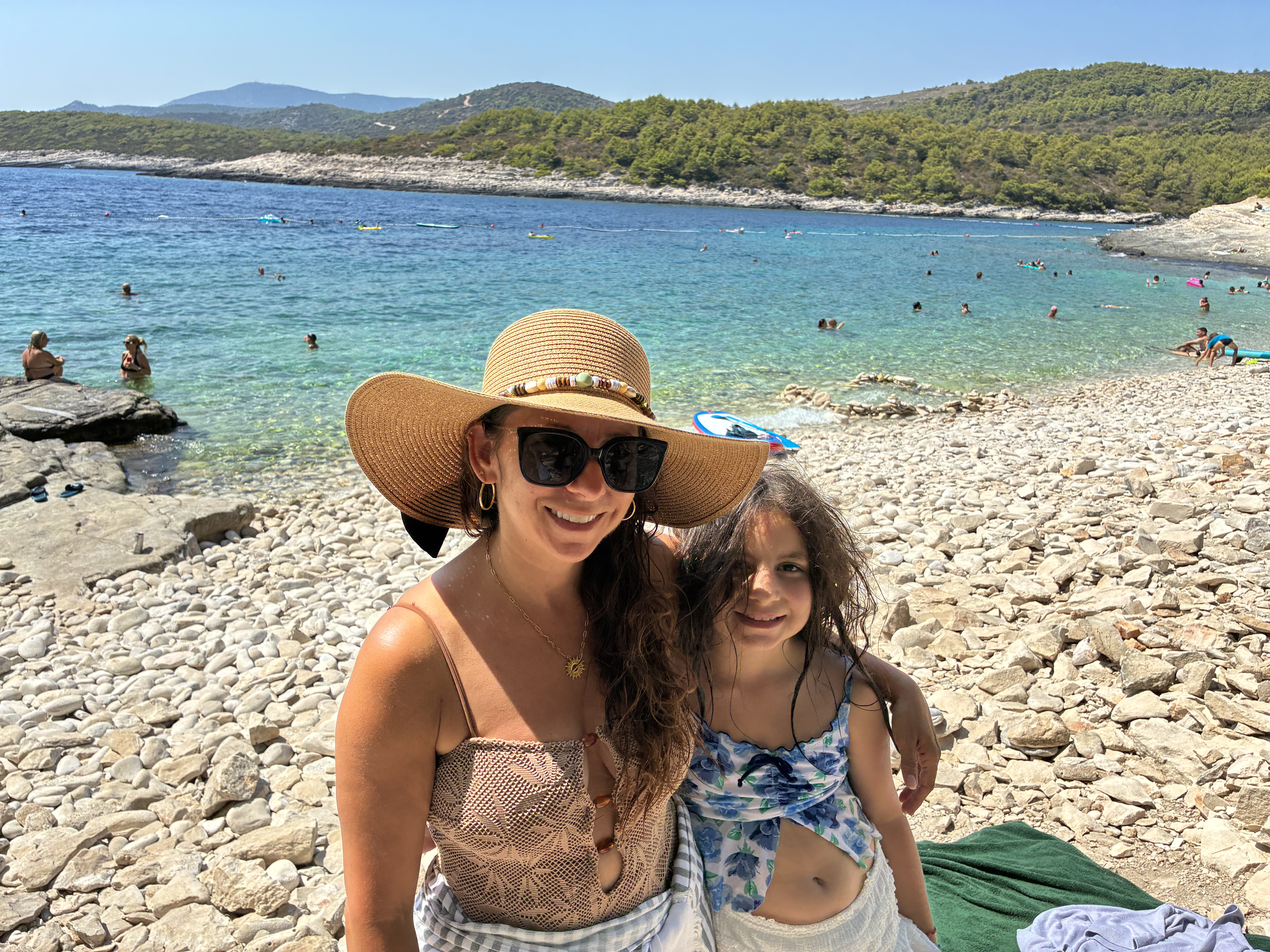
Croatia’s coast is not sandy. It is rocky, white limestone smoothed by the sea, little coves cut into the shore, the water coming right up to the edge so you step in directly. Yesterday Jenifer and I rented a car for 80 euros and drove to the other side of Vis to Diamond Beach and the cove right next to it. I have never seen water that color in my life. I do not have the right word for it. Blue is not right. Clear is not right. It is both and neither and something in between that I have not found a name for yet.
Jenifer says the water feels thick. I think it feels like air. You glide through it. The salt holds you up almost without effort. We were treading water easily twenty feet deep and could see straight to the bottom without goggles. Harper has been teaching the girls to free dive. Avilene has not stopped swimming since we arrived. She spends her days looking for crabs on the sea floor. She has come out of her shell in a way that is specific to this trip and this water and this company and I am watching it happen every single day.
The beach culture.
Jenifer and I appear to be the only two people in Croatia wearing one-piece swimsuits. I am not exaggerating. Regardless of age or body type, this country is fully committed to the bikini and the bottom half is very very small. I feel overdressed at the beach every single day.
And I am over here wondering if I can get up the courage to sport one of these suits. Part of me wants to. Part of me is still very much from Florida. I have not made a decision yet but I am watching these women of every shape and size walk around completely unbothered and thinking… maybe. Just maybe. I will report back.
The pizza.
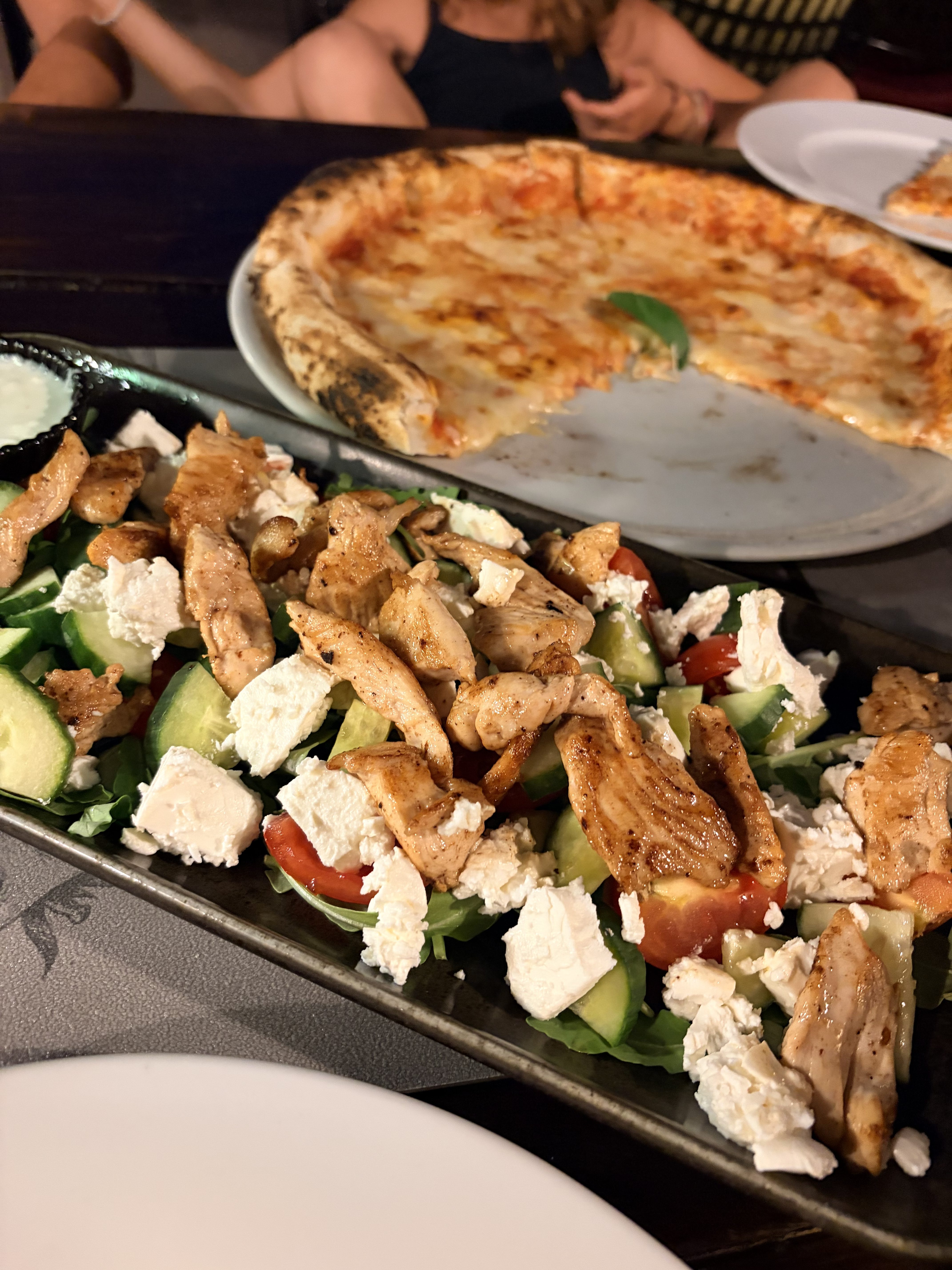
Wood burning oven. The thinnest possible base with a puffy charred outer crust. Cheese melted entirely into the surface. And feta so soft it was almost the consistency of fresh goat cheese, not crumbled, not salty, just soft and creamy and completely perfect. Best pizza of my life.
What I keep thinking about.
Croatia without a boat is still beautiful. Croatia with a boat is something else entirely. So much of the most untouched water, the coves that do not appear on any map, the swimming spots with no roads, is boat access only. If you are planning a Croatia trip and have any flexibility, look into boat charters. Even a half day. The country makes a completely different kind of sense from the water.
And now I cannot stop thinking about how to get back here with all the boys. Adam and Jake and Gavin, all of us, a full month in shoulder season. A place with a view of the sea where we can jump in the water right off the rocks. School in the mornings. The square at night. Cards and gelato and nowhere to be. That is what I want. I am already working out how to make it happen on our route. This country got to me. It really did.
Avilene and I fly back to meet the rest of the family in a few days. She has crab-hunted and free-dived and played cards until midnight and eaten gelato every single day. When I asked her what her favorite part was she did not hesitate.
The water, she said. Obviously.

If Croatia is calling you and you want help building the trip, reach out at nicole@fgluxurytravel.com. I would love to help you plan it.
Share this:

Discover more from Adventures We Seek
Subscribe to get the latest posts sent to your email.